A New Life
November 6, 2016
Hard Times – Lord Corwin
November 7, 2016

I am not a linguist, just a fan of languages. If you are a linguist, disagree with me, or have other strategies, please write an article of your own or message me on Discord. I am always looking for new ways of solving these, and with more minds on the task hopefully the better we get at them.

Besides languages being fun puzzles to solve, with Star Citizen, having real alien languages as a completed stretch goal makes being able to solve them a useful tool. Knowing the Banu phrase for ‘overcharge his ass’ or the Vanduul phrase for ‘contains volatile explosives’ could be useful hints.  In the end, even if Cloud Imperium ends up tossing out the languages, or not having them play a tactical role, other games still use languages heavily and it is useful to know how to decipher them.

There tends to be two main types of languages used in game worlds, the first being barely a language with substitution alphabets. These tend to be English substitutions, but I know of one Japanese substitution as well; the language of the company that made the game tends to be a good starting point. Scripts tend to vary from being elaborate cursive to entirely different scripts. For a good example of custom scripts, Guild Wars 2 has at least three substitution alphabets with the languages used throughout the game world as trivia or Easter eggs. Some games bring these to the forefront as well, in A Story About My Uncle the player is directly told about a script. The first few instances with the alphabet have a NPC guiding the player towards reading it.  From then on, phrases in the alphabet act as gameplay hints or lore pieces. Custom scripts also show up in television shows, such as the Stargate series which has a few with different ‘Ancient Language’ scripts.
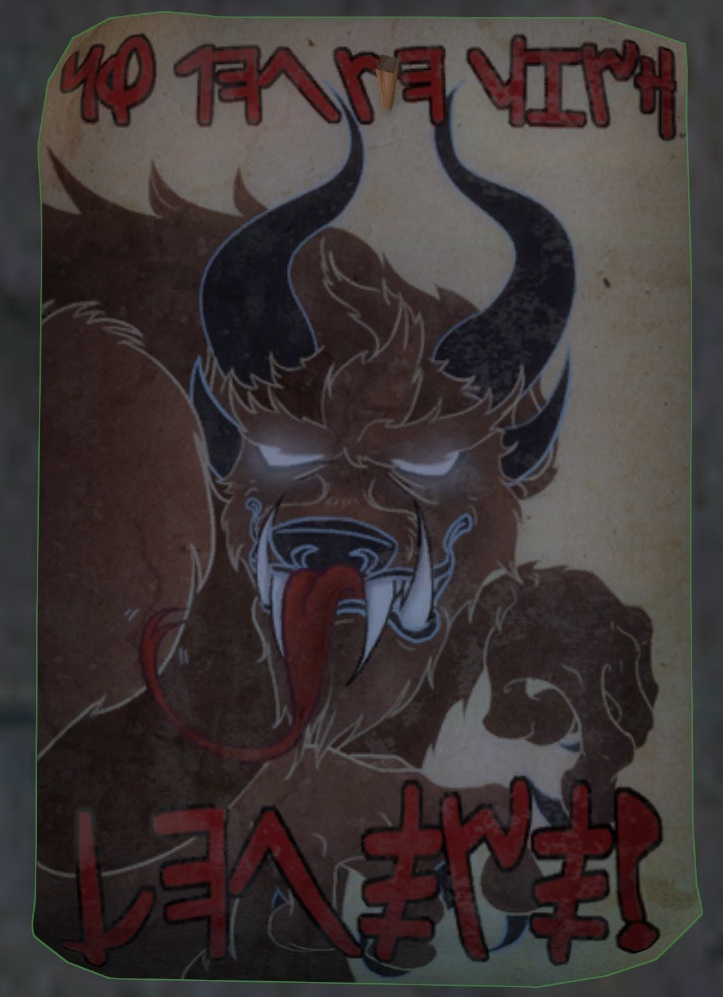
"No peace with beasts" - 'beast' is a slur used against one of the in-game races of Guild Wars 2, characters of that race are harassed by NPC's in the town where these are posted.

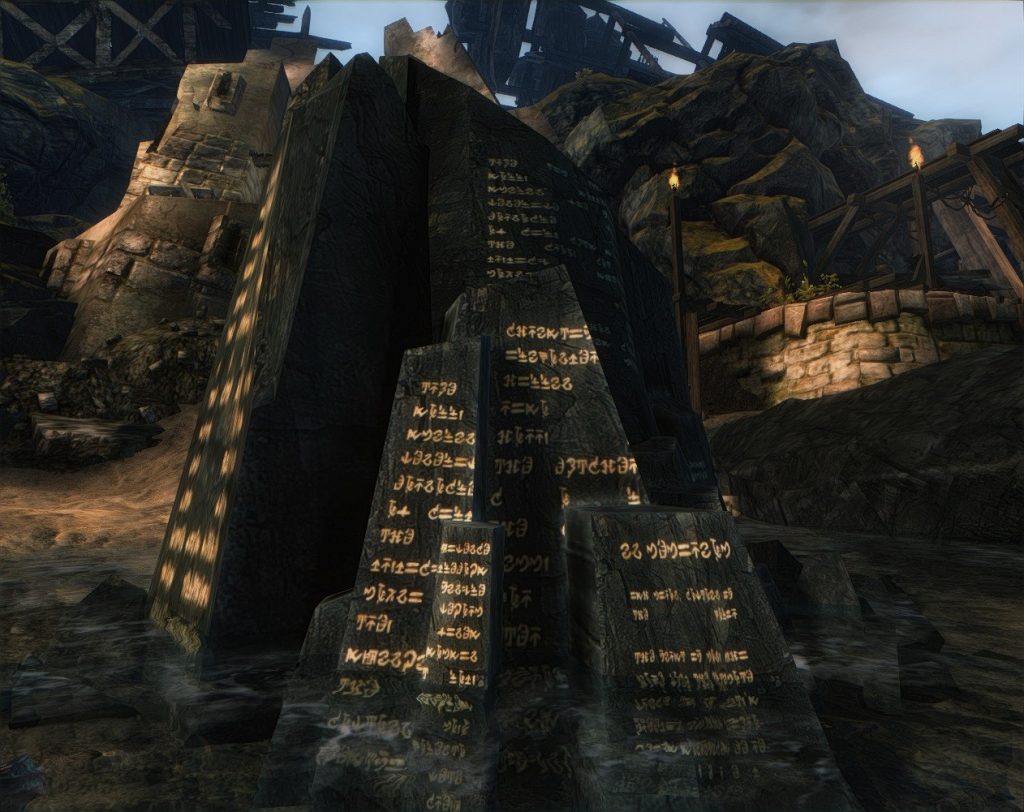
Thankfully, these languages tend to be solvable by persistence over linguistics. Writing down each phrase you find of a suspected language and recognizing repeating patterns tends to be the best way. From there finding the vowels and common constants tends to be easiest (screw finding Z or Q).  If you are lucky, such as with Guild Wars 2, the words will have spaces already; if you are not so lucky, the following tricks can be harder to use. With spaceless languages it is good to remember that no English word will have three of the same letter in a row, for instance in the Atlantis stairway, the third from bottom row on the right says “WILLLAY”; making it kind of obvious how it should be broken up (almost always two to the left, one to the right). From there, three and four letter words tend to be the easiest to find and parse in spaceless languages, where any less than four are easier in spaced languages. With A and I being solo letters, and the end of double letter three letter words tending towards double E and L. A, E, and I can all be found without too much trouble.  Guess-and-check can get you far past that, or heavy use of online crossword solvers. Whatever method you choose, they tend to be solvable if you have enough reference material, time, and scratch paper. It is also good to thing to keep in mind that some languages may be backwards, change directions, or pair letters into single symbols. Warframe, for example, has a direction shifting language; the writing having vowels and consonants positioned over each other depending on the syllable. If you want practice at reading these, Guild Wars 2 is free to play and full of examples, and now many games have at least minor substitution scripts in them.

Now for languages, the crazy uncle that you can’t quite get a grip on. Klingon from Star Trek counts in this, as well as Elvish from Lord of the Rings. Instead of symbols being the focus of the script, full languages are more about context and patterns. The syntax of these languages tend to get complicated fast; adding in non-human species, non verbal communication, or languages that have different constructs than what we are used to; it gets at least a bit confusing. Given there are actual linguists making the language, I can understand them wanting to go out of their way to enjoy the experience of designing them. Sadly, I have little to no experience of deciphering one of these; I’ve only got theories at this point. If we run into them, I feel we all have to play it by ear and try to rip apart the syntax and vocab. If you have suggestions for how to solve these, please let me know.