Awesome Brews #15
September 5, 2016
Strategic Operations Division Report 9-5-2946
September 5, 2016

Demonseed Reviews: No Man’s Sky

No Man’s Sky, the hotly controversial procedural game with more planets than Elite Dangerous.  I just spent the bulk of my weekend immersed in this title and I found it enjoyable, though I don’t know for how much longer.

If you want the TL:DR version of this… too bad.  Read some other review article.  My feelings are mostly the same for the bulk of what’s out there.


Graphics and Art

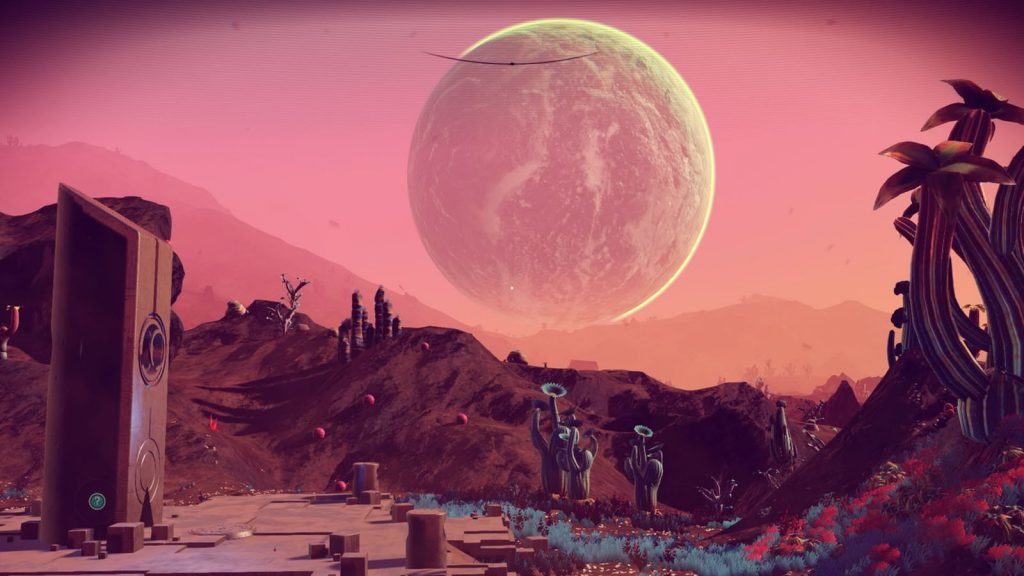
In a word, amazing.  The game is colorful and incredibly beautiful.  Textures seem well suited for whatever you encounter.  The various creatures in the game are all beautifully constructed and all walk, run, bounce, fly or swim very realistically.  Textures on the voxels seemed a bit off.  There was plenty of times I approached a large mound of some material wondering what it was because the metallic textures are so reflective, they took on very different hues depending on the environment.

Space is also very unrealistically colorful; in fact, let’s get that point out of the way here.  The entire game is very unrealistic. If David Braben is the guy who wants to make Elite Dangerous a realistic-as-possible depiction of the actual galaxy, then the developers of No Man’s Sky said they want to go in the completely opposite direction.  Planets have no logical orbits, coloration, or anything and are impossibly close to each other like an old space opera movie.  Space is fantastically colorful, and filled with more asteroids than would be deemed healthy for any life form either in-space or planet side.  Gravity doesn’t exist until you get out of your ship, and your ship will land itself just about anywhere, including halfway inside a hillside or on top of a giant mushroom.  I frequently showed my wife some of the more creative parking jobs the game gave me.  Platinum, Zinc and Thallium grows on plants that can be found on every planet in the universe, Plutonium is found naturally occurring everywhere in giant, red crystals and Copper floats above the landscape.  The developers should have just cut and run, and not used any Earthly element names for the resources at that point.

Ships are somewhat cartoony.  They look like things off a Mattel assembly line than anything realistic and flyable.  The aliens are beautifully done though and show a fair amount of variety.  I’m not sure if a procedural generator was used in their art, or if it was a lot of hand-tooled options.  Aliens are never walking around though.  They’re just sitting around like MMORPG quest givers without the quests.

Sound and Music

The sound effects are very good, especially the ambience on the planets. They’re all clear, distinct and of the highest quality.  Sometimes though I’d hear sounds for no apparent reason.  On a planet with no animal lifeforms for example, I’d hear animal cries in the ambience.  The aliens all grunt out a greeting in their language, but none ever actually speak.  The tools, weapons and personal foley is top notch.  As you run around and affect the world, you hear every out-of-breath pant, every blast from your jetpack, and every blast from your multitool.

The music is all very ambient, mellow and spacey.  The mood it sets for the game is to peace-out and chill, which sets the primary mood of the entire game.  Combat, if it does happen, it’s almost like hard-rock, and is a total grinding-gear-change from the normal ambient music track of the game.  Overall, the music is enjoyable and adds to the theme of the game.  The combat music is somewhat annoying, but in No Man’s Sky, combat can be completely avoided.

The Technical

Here’s where it gets interesting.  No Man’s Sky has ALL the cool tech.  It has procedural everything… procedural name generation, system generation, planet generation, planet surface population generation, creature generation, encounter generation, point-of-interest generation, and resource generation.  It has space to planet transition.  It has point-of-interest prediction – the game can tell you where the next XYZ will generate on a planet, even if it’s on the other side of it).  It has voxel-based resource node gathering; i.e. you destruct the environment gathering resources like Minecraft; in fact, with grenades, the entire landscape is destructible.  Additionally, all this tech is very well done.

The planets are created using simple homogeneous glom-together mechanics, which while primitive are fairly effective.  Basically, the game is taking the planet like a big ball of clay, and procedurally making its terrain based on an algorithm.  Then, all points of interest, it adds on after effect and tries to “blend” the environment to them.  Starports need a large flat surface… but it’s generating it in the middle of jagged mountains… so it creates a plateau for it to sit on and blends it into the environment as best it can.  When it does it well, it looks seamless, or that it belongs there.  Did the plateau exist before, and was an ideal spot to build a starport?  More times than not, it seems that way.  When it doesn’t work well, you have something like an alien monolith in the middle of some mountains at the bottom of an unnatural pit.  Nobody has dared try a more advanced, more daring planetary generator yet in a game, such as a hydroformaic one – one that generates terrain based on the flow of water and the river network, or an erosionary one – one that factors enough plate tectonics to have regions near fault lines usually jagged and mountainous, and areas far from them eroded and worn.  I’m still counting on Star Citizen and Elite Dangerous to break new grounds here.

Resource spawns are all like skyscrapers in the game.  They’re all towering and imposing.  You’ll find multitudes of giant gold phalluses on some worlds.  Iridium always spawns like an arch of stone and copper is apparently weightless since it’s always floating.  Voxel destruction works pretty well, but is prone to “fragments” getting left behind.  Like Minecraft, voxels and the environment don’t obey gravity.  Occasionally, some resource nodes have their voxel nodes inverted.  This produces an interesting effect where the outer layers of the object are destructible, but not the core.  An exploitation of this bug though is that you can carve out the outer layers of the node all the way down to it’s generation point and receive materials the whole time.  The game has a mechanic where only voxels that are “above ground” produce materials, but this only works if the node geometry all points inward to the core.  If it’s inversed, like with this bug, then effectively, all voxels from the core outward produce materials.  The end result, when you find one of these inverted nodes, usually appearing like a column of material rising 30 feet out of the ground, when you leave, you’ll have 2-3 full stacks of material, and a thinner column of the material, still sticking 30 feet above ground, but sitting in a 100 ft deep pit with an air-gap on all sides.

Resource nodes also don’t retain voxel information over distance.  There’s no dynamic LOD with them.   Walk away a few hundred yards and poof, that column of Aluminum you just leveled to the ground is back.  LOD zones beyond the closest ones always show the un-touched, pristine voxel mesh.

Physics are simplistic.  As I mentioned, there’s no gravity aside from on you the player and other creatures alive or rag-doll dead. What gravity there is, also is always the same, regardless of the planet you’re on or moon (a corollary to this, all planets are the same size, as are all moons).  Also, you can climb out of and over any terrain.  There’s no place you can’t jetpack-climb onto or over.  Everything has perfect friction so traction is never a problem.  Space feels like an arcade game.  There’s no inertia.

As far as systems tech goes, this is a PlayStation 4 game first and a PC game distant second.  Some PC game 101 things aren’t present in No Man’s Sky.  You can’t alt-tab out of the game.  Doing so will make you unable to get back into it with no recourse but to forcefully kill it from the taskbar.  It doesn’t even have an icon for the taskbar aside from the Windows default one for executable files. Controls are clumsy at times.  The mouse and keyboard, as you’d expect, are marvelous for the FPS part of the game, but the galaxy map is almost unusable.  There’s no way to easily plot your own course.  You need to rotate the map into a position, then push a direction toward another system to even see anything about it.  Finally: save points, the bane of PC gamers.

The Actual Game

Here’s where No Man’s Sky falls into the pit of No One’s Game.  As impressive as all the technology is in the game, it was like they developed all this technology for the sake of developing it, then, four months from release suddenly said “Oh yea!  We need to make a GAME out of this!”  Your character has no avatar.  You’re just an incorporeal camera wandering the galaxy, until you jump in your ship – then you are your ship.  If I were to go into third-person mode, I would see at best, a floating multi-tool and nothing else.

There’s no boundaries to the terrain.  No mountain you can’t climb; no sheer cliff you can’t scale.  It makes it easy to get around point A to point B as the crow flies, but it makes navigation somewhat boring.  There’s no hazards either except falling and as long as your jetpack has the smallest amount of charge, you can arrest your fall enough to not take damage.  Thus, traversing the terrain isn’t any challenge.  It’s pointing the stick in a desired direction and pushing “W” until you get there, with the occasional jet packing to avoid deadly falls and “shift” to sprint until you run out of energy and have to walk for the next 15 seconds while it recharges.

Most creatures I’ve found are passive and will run away.  This is fairly realistic, but few creatures seem to be territorial and/or aggressive, and the ones that are can be blasted away with a couple bursts from your weapon.  They also don’t behave like a creature would.  You would think experiencing pain from something that shoots a screaming beam of light would instantly send even the most apex predator turn-tail to rethink its strategy, but there is no “shock mentality” or animal psychology to the creatures.  Just a damage threshold.  And they will continue to attack you until you hit it, at which point they will run.

Ship combat is almost neigh impossible.  Your shots have speed to them and there’s no leading reticle to aim for.  It has to be done old-school WW2 tracer style, which wouldn’t be a problem if your weapon didn’t keep overheating and needed to stop firing for the next 10 seconds.  The AI though can sure as heck line up its shots like their bullets were magnetic.  You can never run from space combat either, making every encounter a death sentence.

All can be avoided though, because aside from the occasional critter getting feisty with you, you never have to enter combat.  Even the Sentinels, which are these little robot drone peacekeepers found on every planet in the universe (there’s apparently a back-story to that) are usually non-aggressive unless you start slaughtering wildlife, strip-mining the environment, or destroying property.  On worlds where they are hostile, it’s easy enough to just leave for another world.  There is after all a few quadrillions to pick from.  The omniscient pirates are a lot harder to avoid, because they always seem to spawn in when you’re carrying a hold full of goodies.  Best bet is to try to warp out of the system or land on a planet when you get the announcement they’re coming in.

Finally, there is no multiplayer.  No Man’s Sky is single-player only.  Yes, the game is online, yes, there is a backend server, but it’s only to record your discoveries for other players.  Two players in the same spot on the same planet won’t be able to interact because there’s nothing on the server tracking your position in the universe relative to everyone else.  Another thing, there’s no way to search the galactic map for a system.  You have to hunt for it by hand.  As far as I can find, there is no “find by name”.  Once you’ve left a system far behind you, it’s almost an impossibility to back-track and find it again.  Also, remember how I said you have no avatar?  Yea, problematic.  The only “multiplayer” you’ll see is if you run into a planet someone else found first.

Conclusions

So what does that leave you with game-wise?  A solitary exploration game where you get lost in a massive universe, gathering resources to survive and better you and your ship in order to continue pushing on as you try to reach some foggy existential end-game quest at the center of the galaxy.  Sadly, this is it.  Personally, I don’t mind it.  I find the game quite relaxing and I enjoy free exploration games.  It’s one of the reasons I continue to play Elite Dangerous, but at least in Elite, you can answer the question of “so what do you want to do today” from a list of choices about an order of magnitude longer than those present in No Man’s Sky.  I say sadly, because I feel this game could have been so much more if the developers had put more focus on its actual game design, and I hate to see such an ambitious project bomb because they targeted a type of gameplay that’s not very popular; especially after all the hype.

In the end, I like the game.  I don’t know how much more I’ll continue to play at it, because games like this I tend to play for a while and drop like a rock.  One moment, I’m putting my finishing touches on the most mega-impressive castle I ever made in Minecraft, and then, when completed and ready to go, I never log into that server again.  Few games I ever return to after that happens, but that short list includes World of Warcraft to a point, Minecraft, Kerbal Space Program and Elite Dangerous.

It’s not a game for everyone and I doubt many people in Oddysee will truly enjoy it.  It’s a game where solitude, survival and exploration is more important than reflexes, strategy or teamwork.  I’m sure some of the above-mentioned bugs will be fixed in the upcoming months, and with a PlayStation release and a mighty potent hype-train, I see it at least being a financial success, but beyond that, I’m not sure of its future.  Worth the price tag?  Like all things, it’s worth what people will pay for it.  If you like games of solitude, survival and exploration, then it might be worth that price tag to you.  If not, then if you’re still curious about it, wait till the Christmas Steam Sale 2017 when it’ll be 50% off or better.

Addendum

I wrote the bulk of this review the weekend after it went on sale having played it for much of the entire weekend.  I poked at it a little bit past that, but at this point, I have nowhere left to “advance” to besides getting the materials together to grind to the “end”.  I’m done.  As I said, dropped like a rock.  Total time recorded by Steam: 39 hours.  As pretty as the game is, there’s not enough there for me to want to come back to.